Top 10 IT companies in Dehradun
Posted on March 12, 2026
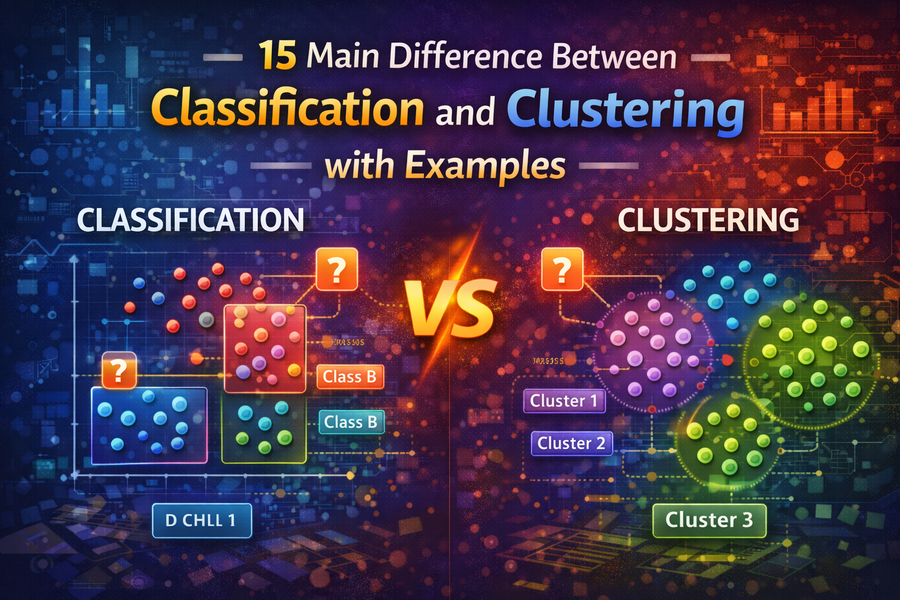
The issue of effectively grouping data is one of the most widespread tasks in data science and machine learning. In order to accomplish this, there are two broadly applicable techniques, which include classification and clustering.
To begin learning data analytics, machine learning, or AI, one needs to understand The Difference Between Classification and Clustering since both approaches to data problems exist to solve.
Let’s start with the basics.
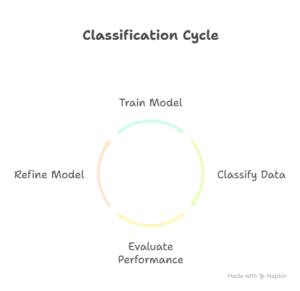
Classification is a machine learning method associated with classifying data into established categories or tags. It is in uncomplicated terms that the model is already aware of the potential answers and acquires the trick of forecasting them correctly.
The concept of classification involves work with data that is already marked, that is, the result of every data point is known. This technique falls in the category of supervised learning, in which the algorithm learns from previous examples.
Take, as an example, when you train a system with emails that are considered spam or not, the model learns to classify new emails based on the patterns.
Clustering is a method of categorizing data into groups (similarities) without any prior labels. The algorithm analyses the data and will create groups on its own (clusters).
It involves working on unlabelled data and is an aspect of unsupervised learning. In this case, the model is not aware of the right answer.
An example is that using clustering can cluster customers based on their purchasing behaviour, even without the knowledge of the categories.
Even though the two methods are involved in data grouping, they have very different purposes and methodologies. The difference between classified and clustered data is mostly due to the existence of labels and prediction.
| Basis | Classification | Clustering |
| Type of Learning | Classification is a form of supervised learning in which the model is trained on known outputs. | Clustering is an unsupervised learning technique where no predefined outputs are given. |
| Nature of Data | Operates on only labelled data that are already in certain categories. | Works with unlabelled data and finds natural groupings automatically. |
| Objective | The key task is to make the right classification of new data. | The objective is to discover hidden patterns or similarities in data. |
| Output Type | Generates pre-determined classes at the time of training. | Produces flexible clusters that may change based on data patterns. |
| Human Involvement | Data labelling and validation need a significant level of human intervention. | Requires minimal human involvement after selecting the algorithm. |
| Predictive Nature | Forecast type that is applied in decision making. | Descriptive in nature and used for exploratory analysis. |
| Training Requirement | Fulfilling a training phase with historical labelled information. | Does not require labelled training data. |
| Evaluation Method | The performance is measured in terms of accuracy, precision, recall, etc. | Evaluation is subjective and often based on similarity measures. |
| Flexibility | Not as flexible due to the predetermined categories. | More flexible as clusters are formed dynamically. |
| Common Use Cases | Applied in spam and fraud detection and medical diagnosis. | Used in customer segmentation, image grouping, and market analysis. |
| Algorithms Used | Uses algorithms such as the Logistic Regression, Decision Trees and SVM. | Uses algorithms like K-Means, Hierarchical Clustering, and DBSCAN. |
| Result Interpretation | Findings are direct, clear and understandable. | Results may require deeper interpretation and domain knowledge. |
| Data Dependency | Very sensitive to the quality of labelled information. | Dependent on similarity metrics and data distribution. |
| Scalability | Scalability is determined by the possession of labelled datasets. | Scalability depends on dataset size and algorithm efficiency. |
| Business Purpose | Assists companies in making accurate categorical decisions. | Helps businesses gain insights and discover trends. |
These concepts become quite easier to understand when viewed in the real-world setting. The examples of classification are centered on the situations when the outcome is known.
Email spam identification: The spam and non-spam labels are applied to the emails based on the already labelled messages.
Performance evaluation of students: Students are considered to be pass or fail on the basis of exam results and attendance.
The other examples of classification are in healthcare. Medical test results are applied to categorize patients as diseased or not and assist physicians in making quicker and more precise consultations.
Based on these illustrations, it can be seen that the primary purpose of using classification is in prediction and decision-making, where categories are predetermined.
Customer segmentation: Customers are classified according to their shopping habits, age, or preferences.
Image grouping and market research are also clustering because of finding patterns.
These illustrations showcase the importance of clustering to take the data apart and uncover commonality, as well as detecting the latent structure without anticipating certain results.
Each of the two methods has good advantages when appropriately applied.
Applications such as fraud detection, spam filtering, and medical diagnosis are best done with classification, as the decisions have to be accurate and interpretable.
Clustering can particularly be useful in market analysis, customer behaviour studies, and recommendation systems. It can be used to give useful information that aids in strategizing instead of predicting by bringing related data points together.
Both classification and clustering are effective data science tools that address different issues. Classification aims at prediction with labelled data, whereas clustering aims at finding patterns in unlabelled data.
However, the difference between classified and clustered data is quite clear, and having been familiar with them, it will be far easier and more effective to adopt the appropriate method in real life.
No. Both are used for various purposes based on the data and purpose.
Yes. Data exploration before the construction of classification models is often performed by using clustering.
Outputs are clear, and that is why it is usually easy to understand classification.

Helping content is a content write who loves to right about the Technology, Home Decor, and Sprituality. When he is not writing he might be doing skydiving.

Posted on March 12, 2026

Posted on March 11, 2026

Posted on February 13, 2026