Top 10 IT Software companies in Vizag
Posted on January 02, 2026
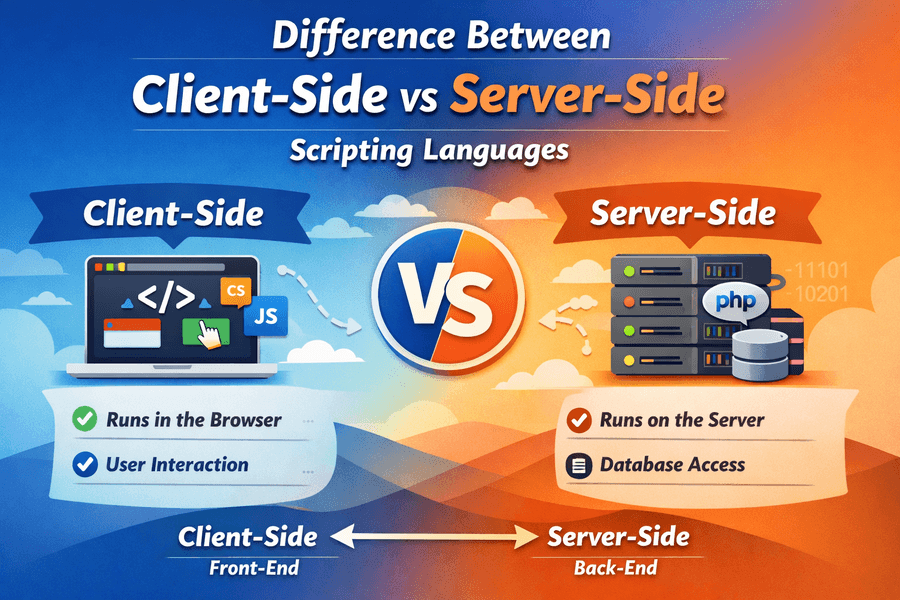
Whenever you open a web page, complete a form, or even tap a button, a lot goes on behind the scenes. Some occur immediately in your browser, and there are those whose processing occurs on a remote server.
This generic working principle explains why there is a difference between client side and server side scripting languages, which has a significant influence on the operation of modern websites in a seamless manner.
To understand this properly, let’s start from the very basics.
The behaviour of a site is controlled using a scripting language. It assists a website to respond to clicking on a button, filling in a form, or any other manner in which the user interacts with the website.
Without scripting languages, websites would remain as such, just presenting fixed information. Through scripting, the websites become dynamic, interactive, and responsive differently to different users.
The scripting languages can be classified into two types, as far as the execution of the code is concerned: client-side scripting and server-side scripting. It is this division that forms various duties of each type.
Client-side scripting is the code that is executed on the web browser of the user. Once a webpage is loaded, the browser downloads this script and runs it on the local computer of the user.
Due to this fact, client-side scripting tends to be extremely fast and give instant feedback.
This kind of scripting is principally applied to enhance user experience. It is used to perform such tasks as validation of form entries before submission, displaying error messages, developing animations, and dynamically updating the page without reloading.
A user can technically view the code since it is a browser program, and that is why client-side scripting does not suit handling sensitive data.
The server-side scripting operates in a totally different manner. This code is executed on the server of the site instead of being executed in the browser.
Each request by the user, be it a process of logging in or a request form, gets processed by the server, the necessary logic is executed, and the result is sent to the browser.
Scripting on the server side takes care of the activities that involve security and handling of data. It deals with user authentication, database services, payment, and customized content.
Since this code is recorded on the server and is never displayed to the users, it is much more secure when compared to client-side scripting.
Knowing the difference between client side and server side scripting languages assists the beginner with the knowledge of how websites are actually run in the background.
| Basis of Comparison | Client-Side Scripting | Server-Side Scripting |
| Where it runs | Runs in the user’s web browser | Runs on the website’s server |
| Execution time | Executes after the page loads in the browser | Executes before the page is sent to the browser |
| Speed | Faster for simple tasks and interactions | Slightly slower due to server processing |
| Security | Less secure because the code is visible to users | More secure, as code is hidden from users |
| Database access | Cannot directly access databases | Can access and manage databases |
| User interaction | Handles form validation, animations, and UI effects | Handles login, authentication, and data processing |
| Server load | Reduces server load | Increases server load |
| Performance dependency | Depends on the user’s device and browser | Depends on server performance |
| Code visibility | Visible and accessible to users | Not visible to users |
| Main purpose | Improve user experience and responsiveness | Manage business logic and sensitive operations |
| Common languages | JavaScript | PHP, Python, Java, Node.js |
| Best use case | Instant feedback and interactive features | Secure data handling and backend processes |
Client-side scripting is significant to the development of smooth and responsive sites.
Server-side scripting is needed to deal with valuable backend tasks.
The decision on the correct type of scripting is task-dependent.
Both are combined to perform and offer maximum security in real-world websites.
Simply, difference between client side and server side scripting language in terms of the code running location and what the code does.
Client-side scripting is user-interactive and fast, whereas server-side scripting is logic-based, as well as security-oriented and data-oriented.
Knowing the two assists beginners to understand how contemporary websites work and why the two sides play a crucial role in the development of strong web applications.
No, it is less secure due to the possibility of users viewing the code and changing it by users.
Only bare bones websites can. Server-side scripting is needed for dynamic websites.
Client-side scripting is the language selected by most beginners since it is much easier to see and comprehend.

Helping content is a content write who loves to right about the Technology, Home Decor, and Sprituality. When he is not writing he might be doing skydiving.

Posted on January 02, 2026

Posted on January 01, 2026

Posted on December 31, 2025