Top 10 IT companies in Dehradun
Posted on March 12, 2026
![Difference Between DDoS and DoS Attacks [Detailed]](https://www.helpingcontent.com/wp-content/uploads/2026/01/Difference-Between-DDoS-and-DoS-Attacks-Detailed.png)
Websites do not tend to crash without any cause. When they do so, it is usually the case that someone is purposely attempting to overwork the system.
Two typical methods of this occurrence are DoS and DDoS attacks. The two serve the same purpose of blocking access of real users to a website or online service, but they operate in quite different modes.
Having the difference between DDoS and DoS attacks may enable businesses to realize what type of risk they are facing and to what extent the effects can be serious.
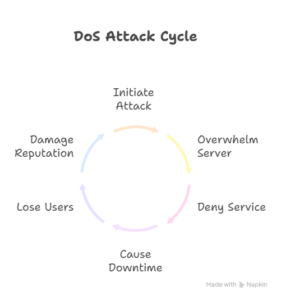
A DoS (Denial of Service) attack refers to a cyber attack in which one system makes numerous requests to a server or a webpage. The idea is straightforward: flood the server to the extent that it is unable to serve actual user requests.
In a DoS attack:
The attacker being initiated by a single system is therefore easier to identify and prevent. Nonetheless, any simple DoS attack may lead to downtime, loss of users, and damaged reputation of the business.
A DDoS (Distributed Denial of Service) is a more sophisticated and dangerous attack than a DoS attack. Rather than a single system being attacked, several compromised systems attack a target simultaneously.
In a DDoS attack:
Large businesses, financial websites, and popular sites are attacked with DDoS attacks.
The difference between DDoS and DoS attacks is principally the magnitude and origin of the attack. Although both of them are aimed at rendering a webpage or a server unusable, their functionality and the extent of their harm are quite dissimilar.
| Basis of Comparison | DoS Attack | DDoS Attack |
| Source of attack | Single system | Multiple systems |
| Traffic volume | Low to moderate | Extremely high |
| Detection | Easier to detect | Difficult to trace |
| Attack complexity | Simple | Highly complex |
| Impact on the server | Slows down or crashes | Completely overwhelms |
| Prevention difficulty | Easier | Requires advanced protection |
| Duration | Short-term | Can last hours or days |
Flood Attacks: The huge volume of requests that one source sends to the server causes the bandwidth of the server to overload, making the website slow or unavailable.
Ping-Based Attacks: In this attack, there is a repetition of the ping requests so that the server resources are overexploited and cannot respond to the actual users.
Traffic Flooding Using Botnets: Various systems under attack submit large amounts of traffic to a target simultaneously, and therefore, it is hard to block the assault.
Application-Layer Attacks: These attacks are directed at particular functions of a site, such as a page of the site used to log in, and this leads to disruption of services, but in the guise of normal traffic.
Protocol Attacks: The protocol attacks take advantage of network protocol vulnerabilities, and they continue to occupy the resources of the servers until the system is brought down.
Every attack applies a variation of the approach, yet the objective is the same: to render the service unavailable.
DoS and DDoS attacks may lead to significant losses to businesses, regardless of the time frame during which the attack is in place.
They can lead to:
In the case of businesses that rely on online business, such attacks may halt operations and stifle growth.
Simple preventative action can go a long way in minimizing danger and effect.
These include:
It is always better to prevent rather than cure an attack once it has started.
DoS/DDoS attacks can be considered technical, yet their effects are not fictitious. Any slowness in the site, frequent unavailability, and even total shutdown of the service may easily drive away customers and ruin credibility.
However, the difference between DDoS and DoS attacks is much more violent and can hardly be controlled.
Learning the distinction between DDoS and DoS attacks enables business ventures to consider security as seriously as it is, rather than acting upon the consequences.
Most attacks can be prevented or detected early enough, especially with the correct protection and monitoring.
Talk to our experts, we make businesses remain secure to enable them concentrate on growth without having to worry about downtimes.
DDoS attacks are larger and more complex, and thus more damaging.
Yes, DoS and DDoS attacks are both cybercrimes.
DoS attacks are normally brief attacks, and DDoS can take days.

Helping content is a content write who loves to right about the Technology, Home Decor, and Sprituality. When he is not writing he might be doing skydiving.

Posted on March 12, 2026

Posted on March 11, 2026

Posted on February 13, 2026