Top 10 IT Software companies in Vizag
Posted on January 02, 2026
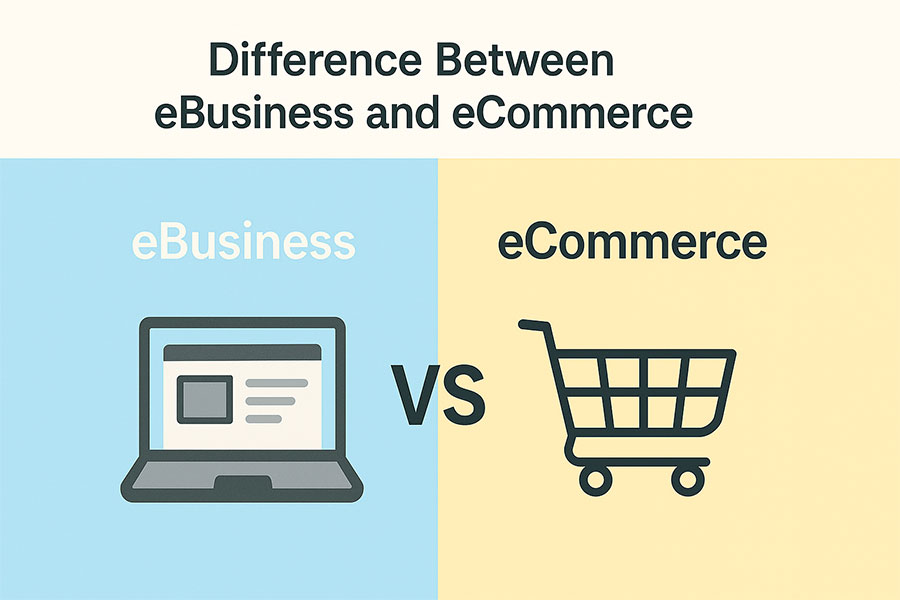
Digital transformation has not only altered the way business is done, but it has also re-invented the whole format of entrepreneurship in 2026.
Despite innovation and ease, it creates a big confusion among founders, marketers, and even students: the difference between eBusiness and eCommerce.
This breakdown will make it a lot easier in case you are trying to figure out what each of them really is and what one your business actually requires.
Both these terms are used interchangeably, but the difference between the two is now more than it has ever been.
eBusiness refers to the digitalization of the whole business process. It includes internal business processes, as well as customer relationship management, logistics, procurement, and even human resource functions.
eCommerce, however, is basically the online transaction component that includes buying, selling, payments, and fulfilment.
The figures almost represent the entire story. Retail eCommerce continues its upward trend and is projected to reach $6.88 trillion by 2026, constituting over 21% of the total retail worldwide. In India, the pace of growth is even greater; the market will be in the range of 163 billion, with a colossal CAGR of 27%.
B2B is an entirely different story. In 2026, B2B eCommerce will have reached nearly five times the size of B2C because of is projected to hit $36 trillion. And with approximately90% of B2B companies transitioning to digital selling models post 2020, eBusiness has effectively turned into the business backbone of how companies do business daily.
In simple terms, the eBusiness and eCommerce are booming businesses, but even the greatest digital transformation that is occurring within firms (eBusiness) is accelerating at an even greater pace.
| Basis | eBusiness | eCommerce |
|---|---|---|
| Primary Focus | Internal + external online operations: HR, CRM, logistics, finance, analytics, workflows. | Online storefront operations: sales, checkout, shipping, returns. |
| Scope | Broad: This is the whole business ecosystem. | Narrow- only deals with revenue-generating online transactions. |
| Core Objective | Make processes more efficient, cheaper, automated, and more productive. | It will help create online sales, develop revenue, and enhance online customer acquisition. |
| Activities Covered | Inventory, accounts automation, digital marketing, CRM, ERP, customer service automation, and orchestration. | Products, cart management, payments, filling orders and returns. |
| Customer Interaction | Indirect- under systems, service platforms, automated tools. | Direct – customers get to browse, shop, pay and monitor orders online. |
| End Users | The staff, the suppliers, the management teams, and the internal stakeholders. | B2B buyers, consumers, shoppers. |
| Revenue Generation | Not necessarily direct – can be in aid of operations rather than sales. | Always direct – deals make money. |
| Visibility to Customers | Internal systems are mostly behind the scenes; they are not visible to the customers. | Very conspicuous – product pages, websites, checkout. |
| Integration Dependence | High – needs to be integrated in HR, finance, supply chain, marketing, and sales. | Moderate – combines with logistics, payment gateways and marketing tools. |
| Relationship to Each Other | eCommerce is under the umbrella of eBusiness. | eBusiness has a subdivision called eCommerce. |
The following are some of the most obvious examples to demonstrate the difference:
Companies that fail to understand this difference tend to limit their expansion. Businesses whose digital transformation is limited to the outlook of sales (eCommerce) overlook the efficiencies and scales of sheer eBusiness adoption.
Here’s why it matters:
As an example, a company can be performing well in its online sales (eCommerce) and have a poor inventory management or logistics processes (eBusiness). Such a gap results in delays, returns, losses, and customer experience.
The companies that integrate both models are those that will become victors of the digital race in 2026.
At the end of the day, understanding the difference between eBusiness and eCommerce just makes things easier. One is the internal operations of your business and the other one is the online selling of your business. Both are important, both are increasing rapidly and both have the capacity to transform the entire way in which a company operates in 2026.
However, the actual victory occurs when a company is aware of what it really requires. Some brands require improved systems, automation, and order (eBusiness). Others require visibility, customers and online sales (eCommerce). And others must have both– at other degrees.
In case you have plans to expand this year, it is likely the right moment to reconsider the extent to which your business is digitalized, and to what degree it has to be.
The major distinction: eBusiness covers all the digital activities within and outside a business, whereas eCommerce is limited to online dealings of goods/services.
Yes – such as a manufacturing company can have internal activities digitalized, supply-chain and customer service, but not provide a direct sale to consumers via the internet. That is eBusiness without a consumer-oriented eCommerce storefront.
AI/automation streamlines internal workflows and operations as well as decision-making in eBusiness. The customer experiences, personalization of offers, inventory control and conversion are examples of ways in which in eCommerce the same technologies can improve.

Ronak Dave is a full-stack developer and IT consultant with over 8 years of experience designing scalable web applications, backend systems, and cloud infrastructure. He has worked with multiple startups and enterprises, helping them build high-performance systems using Node.js, Python, PHP, Laravel, React, Docker, and AWS.

Posted on January 02, 2026
Posted on January 01, 2026

Posted on December 31, 2025