Top 10 IT companies in Dehradun
Posted on March 12, 2026
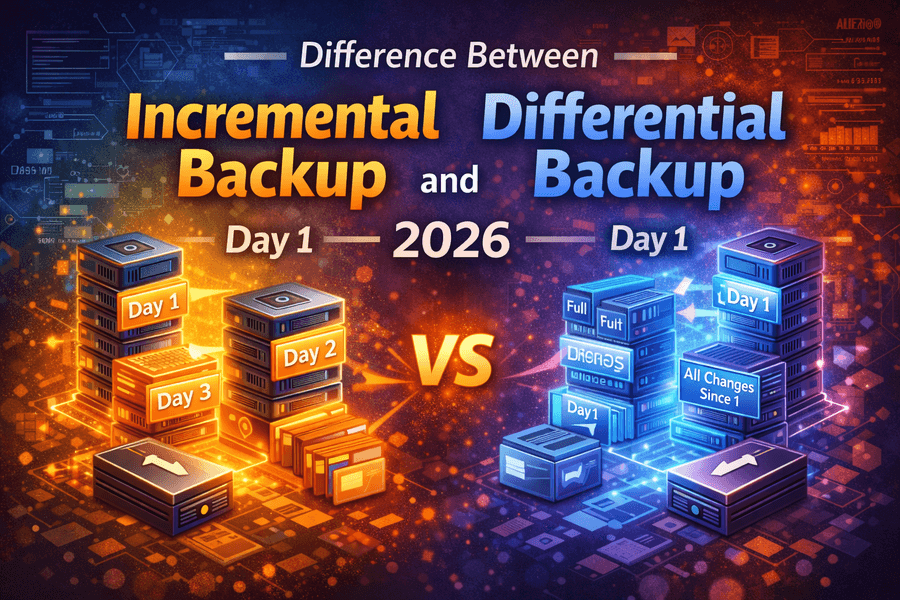
In the modern digital era, any loss of data may occur at any time through failure of a system, cyber attack, or human mistake. That is why it is more crucial to know the difference between incremental backup and differential backup than at any previous time, like in 2026.
These two backup systems are popular to secure data and are applied in different ways and to fulfill various purposes.
We are going to make it easy to understand in this blog since, in simple terms, every step can be clearly explained so that even an uninitiated person can be able to know how they work and which one suits them best.
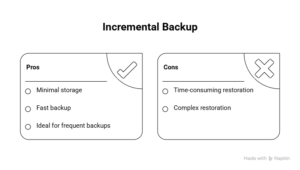
Incremental backup refers to the backup only being the changes since the time when you last took the backup. It does not have to copy all your data once more; it only copies the new or updated files, and this way it saves more time and consumes less storage.
The process of restoration is time-consuming due to the requirement of several backup files.
Differential backup stores all the data that has changed since the last full backup, every time it is executed.
| Basis | Incremental Backup | Differential Backup |
| Data Backed Up | Backs up only the data changed since the last backup | Backs up all data changed since the last full backup |
| Storage Space | Uses very minimal storage | Requires more storage as data grows |
| Backup Speed | Very fast due to smaller data size | Slower than incremental but faster than full backup |
| Restore Time | Slower because multiple backups are needed | Faster because fewer backup files are required |
| Dependency | Depends on all previous incremental backups | Depends only on the last full backup |
| Risk Level | Higher risk if one backup file is corrupted | Lower risk and more reliable |
| Best Use Case | Frequent backups with limited storage | Systems requiring faster recovery |
| Cost Efficiency | More cost-effective for storage | Slightly higher storage cost |
Incremental backup is made to be fast and efficient. It saves only altered data, hence it saves a lot of storage and time taken in backing up.
Key Advantages:
Incremental backups particularly feature well in companies that generate data on a regular frequency and require fast backups without necessarily having to take up a lot of resources.
The restoration process can be longer, though, since many backup files have to be run one after another.
Differential backup is concerned with reliability and quick recovery. It keeps all the changes that occurred since the last full backup, hence the restoration of data is easier.
Key Advantages:
Differential backups take a lot of space in the long term, but provide peace of mind. In the event of system failure, it takes less time and complexity to recover as opposed to incremental backups.
The selection of an appropriate backup plan in 2026 would be conditional on the size of data, recovery time, and storage.
Choose incremental backup if you need:
Choose differential backup if you need:
A hybrid form is applied in most organizations in 2026, where full, incremental, and differential backups are combined to achieve the best security and performance.
The selection of the appropriate backup strategy is not an option anymore, but a necessity. Knowing the Difference between incremental backup and differential backup will make you save your data effectively and spend less time and resources.
Unless you wish to go forward with this insecure, limited, and outdated backup plan in 2026.
Differential backup is less difficult and faster to restore.
It is also unsafe in case a single file in the backup gets spoiled.
Yes, numerous systems are applied to make the systems more efficient and safe.
Incremental backup is high-speed since only small changes in data are backed up.

Helping content is a content write who loves to right about the Technology, Home Decor, and Sprituality. When he is not writing he might be doing skydiving.

Posted on March 12, 2026

Posted on March 11, 2026

Posted on February 13, 2026