Top 10 IT Software companies in Vizag
Posted on January 02, 2026
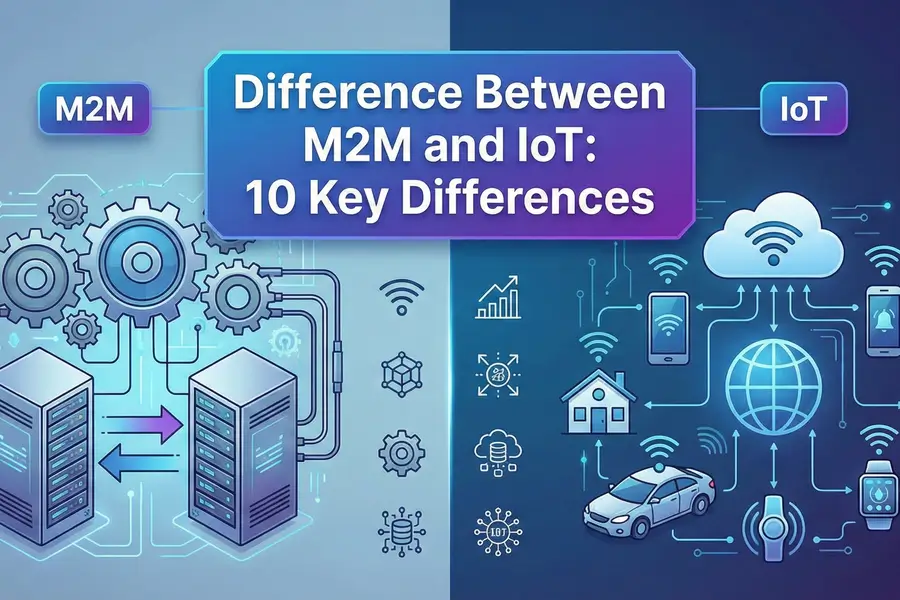
Nowadays, with an over-connected digital world, machines everywhere are communicating quietly in the background to ensure systems are running smoothly. Connections drive such things as smart homes and wearable devices, industrial automation and transport, and much more. However, many people still confuse the difference between M2M and IOT, often using both terms interchangeably.
Despite the similarity in that they require communication between a device and a human being without any human interference, their own technology, size, and actual usage are very diverse. These differences are imperative to the businesses, which intend to implement modern and future-ready digital infrastructure.
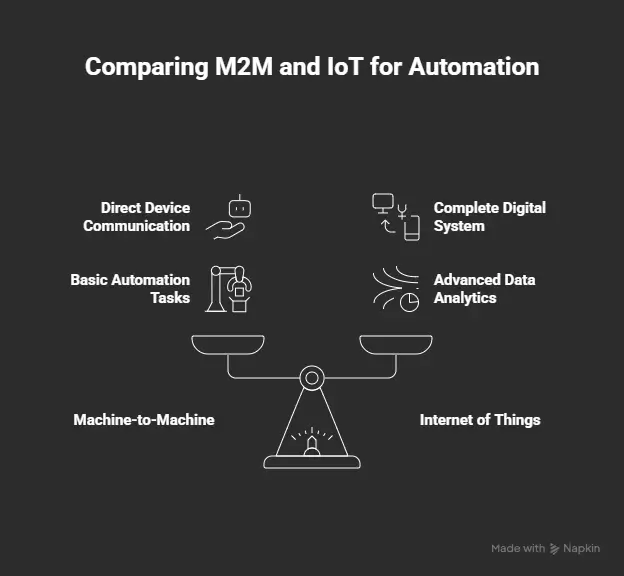
Machine-to-Machine (M2M) can be defined as direct communication between a couple or more machines, connected either by wire or wirelessly. These machines convey information without human intervention. M2M has been deployed in the manufacturing, logistics, and utilities industries for many decades to perform activities such as meter readings, equipment monitoring, and fleet tracking.
The Internet of Things (IoT) is denser in the sense that physical objects (things) are related to the internet and can gather, distribute, and analyze information using cloud services. IoT enables real-time monitoring, remote control, data analytics, integration of artificial intelligence, and communication with users through dashboards or mobile applications.
In simple terms, M2M is more concerned about the communication between devices, whereas the IoT develops a complete digital system in which connected objects are present.
M2M tends to be point-to-point machine-to-machine communication. The relationship tends to be closed-ended and secluded. IoT is an internet-based communication that builds connections between devices via cloud networks and has global communication.
M2M uses either dedicated or private networks such as GSM, CDMA, or a wired option. IoT provides access over IP-based public networking and cloud computing environments, which makes it globally accessible.
M2M systems are not scalable as every new machine must be configured and connected. IoT is also very scalable where thousands of even millions of devices can be easily added with the help of cloud platforms.
M2M is more concerned with the gathering and transfer of raw data and simple processing. IoT facilitates highly intelligent analytics, real-time tracking, predictive maintenance, and artificial intelligence-driven decision-making.
M2M systems are normally run in the background with very little human interaction. The IoT systems have user interfaces, dashboards, and mobile applications that are used to monitor and control.
M2M systems are usually configured to handle particular tasks and can rarely be connected with other platforms. IoT has been crafted to be able to integrate various devices, platforms, and industries.
M2M is inflexible because it is task-based and has proprietary protocols. IoT is not restrictive and can work with numerous communication protocols such as MQTT, HTTP, and CoAP.
M2M is primarily applicable to manufacturing (plants), utility meters, and vehicle tracking. IoT is applicable in smart homes, healthcare, agriculture, smart cities, retail, and consumer electronics.
M2M security is less complex as it operates on closed networks and little exposure. IoT requires a sophisticated cybersecurity system because it is online all the time, stored in the cloud, and has a variety of different devices.
M2M is appropriate when it comes down to simple automation but not very adaptable to smart ecosystems in the future. IoT is innovatively oriented and offers artificial intelligence, big data, automation, and digital transformation.
| Feature | M2M | IoT |
|---|---|---|
| Communication | Point-to-point | Internet-based |
| Network Type | Private or dedicated | Public IP & cloud networks |
| Scalability | Limited | Highly scalable |
| Data Processing | Basic data exchange | Advanced analytics & AI |
| User Interaction | Minimal | High via apps & dashboards |
| Integration | Difficult | Easy and flexible |
| Flexibility | Rigid | Highly flexible |
| Applications | Industrial & utilities | Smart homes, cities, and healthcare |
| Security | Closed system security | Multi-layer cybersecurity |
| Future Readiness | Limited innovation | High innovation potential |
The rise in the use of connected devices worldwide explains why IoT has become much greater than the conventional M2M systems. It has been projected that by the end of 2025, the total number of connected IoT devices in the world will rise to more than 21 billion and by 2030, the number is predicted to rise above 39 billion. The catalyst for this bombastic expansion is smart homes, wearable technology, and industrial IoT.
Conversely, the traditional M2M interactions have expanded gradually yet less aggressively and primarily in the areas of industrial automation, transportation, and utilities. By 2024, the global cellular IoT and M2M connectivity revenues will have reached over €14 billion and will keep growing, as industries are automated in the digital sector.
These statistics provide a clear illustration of the fact that IoT is evolving into a non-supporting but a business driver in every industry.
The Difference Between M2M and IOT lies in their scope, connectivity, scalability, and future potential. M2M has been an industrial automation tool and has been used for years, where machines communicate directly with each other. But IoT has brought this to an entirely new level by maintaining a link of devices to the web and cloud solutions, analytics, computers, and interfaces.
Although M2M is still in demand in the local and legacy systems, IoT will dictate the future of smart technology, automation, and digital transformation of industries. Metacognition of such differences can assist businesses to make more appropriate decisions on technology and develop systems that are scalable, secure, as well as future-wise.
No. M2M is concerned with machine-to-machine communication, frequently via closed networks or dedicated networks. IoT, conversely, provides connectivity to the devices to the internet and cloud infrastructure, allowing massive data analysis, distance monitoring, and intelligent automation. M2M may be a component of the IoT solution, and they are not the same.
Yes, in many cases they can. With the introduction of cloud integration, APIs, and analytics layers to existing M2M infrastructure and internet connectivity, businesses may now turn their traditional systems into full IoT solutions without necessarily rebuilding them.
The M2M can be routed on closed, private networks and this minimizes exposure, although it can be susceptible to the network unless well handled. IoT systems tend to be more vulnerable in that they rely on civic networks and clouds, but are also capable of advanced, multi-layered security guardians in case it is implemented accordingly.

Helping content is a content write who loves to right about the Technology, Home Decor, and Sprituality. When he is not writing he might be doing skydiving.

Posted on January 02, 2026
Posted on January 01, 2026
Posted on December 31, 2025