Top 10 IT companies in Dehradun
Posted on March 12, 2026
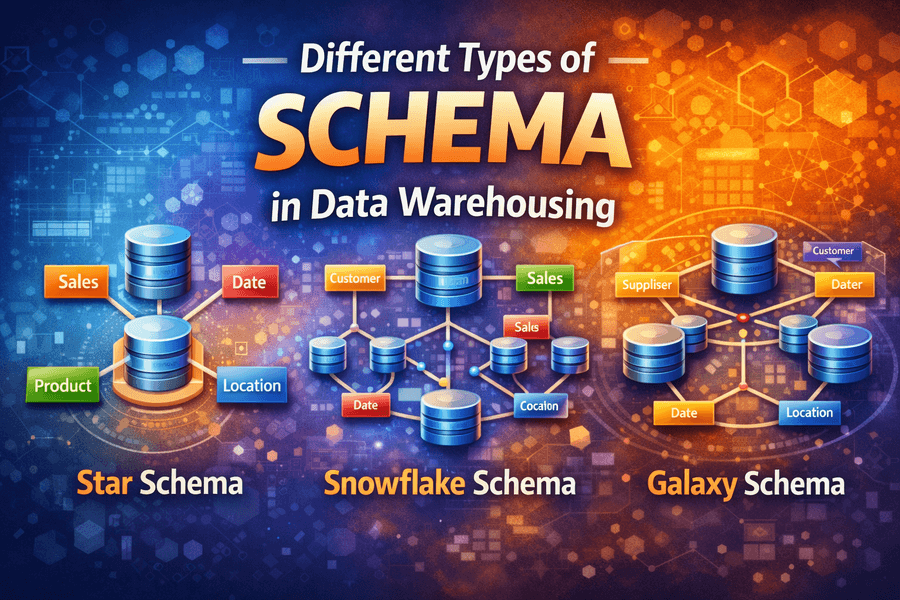
Organizing the data becomes essential when businesses begin to deal with a vast amount of data. The Types of Schema in Data Warehousing contribute significantly to the effectiveness with which the data is stored, retrieved, and analyzed.
To a beginner, schema design may be very technical-sounding, yet the truth of the matter is that it is merely organizing data in such a manner that reporting and analysis become more convenient and quicker.
This blog begins at the bottom level and progresses step by step, discussing the functionality of schemas in data warehousing, their significance, and the key types of schema employed in real-world systems.
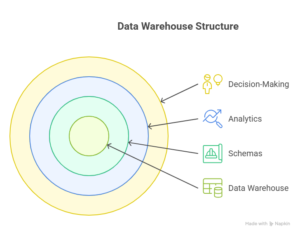
One should first know what a data warehouse is before reading about learning schemas.
A data warehouse is a central repository of large volumes of organized information gathered by various means, including applications, CRM systems, websites, and transaction databases.
The data warehouses are also designed to be analysis and reporting intensive, as opposed to daily transactions, which is the case with regular databases.
In a data warehouse:
Schemas are the logical blueprint that defines how this data is organized inside the warehouse.
To get the type of schema, it is first necessary to have an idea of what is schema in a data warehouse.
A schema is an organized structure according to which data is organized with the help of tables, relationships, and keys. It is a map that explains to the data warehouse how the facts (numerical data such as sales or revenue) relate to the dimensions (descriptive data such as customer, time, or location).
Schemas help:
Data warehouses have three common schema designs, which are utilized for various business and analytical requirements.
The most basic and the most commonly used schema design is the Star Schema. It has one central fact table related to several dimension tables, which constitute a star.
Star Schema is simple to understand and very efficient in querying. Fewer joins are needed to load reports and dashboards; therefore, it is perfect for business intelligence tools.
Best suited for: There are sales analysis, marketing reports, dashboards, and small to medium-sized data warehouses.
Limitations: Increased storage consumption as well as less flexibility in very complicated data associations.
Snowflake schema is based on a more structured and normalized version of the Star Schema. In this design dimension, tables are divided into several related tables to minimize redundancy.
This schema increases the efficiency of storage and data consistency, but queries can be longer due to the necessity of several joins. It needs a greater technical comprehension too, than Star Schema.
Best suited for: Big and complex dimension data and storage optimization needs.
Limitations: Reduced query performance and complexity of design.
The most developed type of schema is the Fact Constellation Schema. It has several fact tables that have common dimension tables, and therefore, analysis can be done on more than one business process.
The schema facilitates such complex requirements of analysis, like the analysis of sales, inventory, and shipping.
Best suited for: Data warehouses and multi-department analytical systems at an enterprise level.
Limitations: Slower query performance, increased design complexity, higher maintenance effort, and the need for advanced technical expertise.
The ultimate decision must be able to strike a balance between query performance, complexity of the system, and scalability in the future so that the data warehouse is not overwhelmed by the increasing volume of data and business demands.
The design of the schema is the foundation of the data warehouses, and to create efficient warehouses, the schema design needs to be understood.
Each type of schema has its purpose, and nothing fits all. Learning the structure of data in schemas and how they assist data analytics can enhance the accuracy, speed, and efficiency of reporting by the business.
Choosing the correct schema will make your data warehouse scalable, efficient, and user-friendly as long as there is an increase in data over time.
The simplest one is the Star Schema due to its simplified structure and quicker queries.
Yes, large data warehouses tend to combine the types of schema depending on the requirements of the business.
Indeed, schema design directly affects the speed of efficient execution of queries.

Helping content is a content write who loves to right about the Technology, Home Decor, and Sprituality. When he is not writing he might be doing skydiving.

Posted on March 12, 2026

Posted on March 11, 2026

Posted on February 13, 2026