Top 10 IT companies in Dehradun
Posted on March 12, 2026
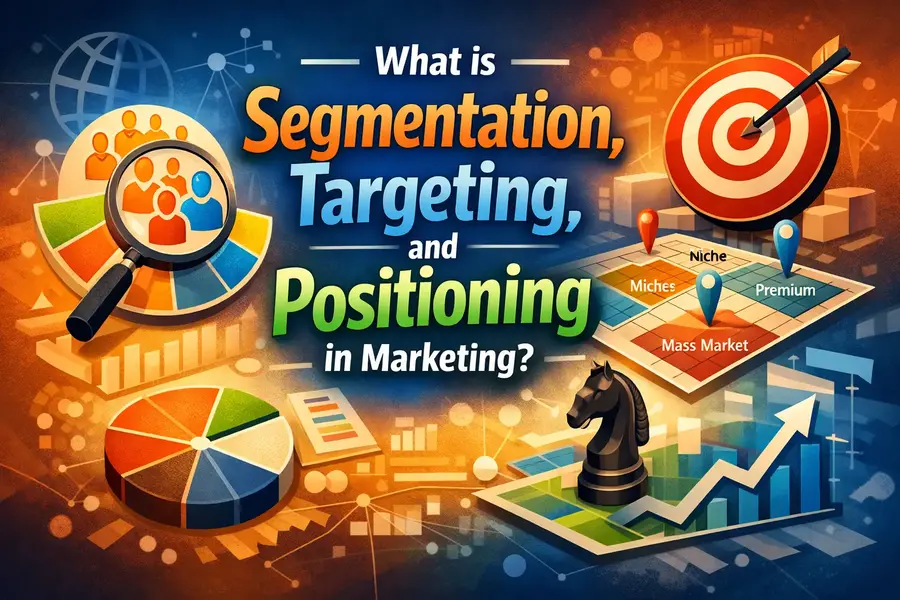
Marketing is not the art of selling the same product to all. There are various individuals with diverse needs, tastes, and purchasing patterns.
This is the reason why knowledge of Segmentation Targeting and Positioning is crucial to every business organization that wishes to develop sustainably.
Companies do not spend time and money on unplanned promotions; instead, they resort to a systematic method to find the appropriate audience and make their value obvious.
The competitive business market today requires that any business that has a deep understanding of its customers will always excel compared to one that plays with guesses.
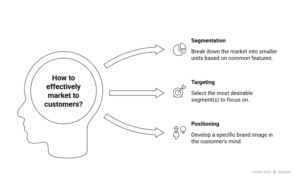
Segmentation, Targeting, and Positioning, also known as STP, is a strategic model of marketing that assists companies in finding their perfect customers and marketing to them most effectively.
Segmentation involves the process of breaking a large market into smaller units depending on common features. Targeting entails choosing the most desirable segment/ segments to target.
Positioning is concerned with the development of a certain brand or product image in the mind of the customer. Combined, STP assists businesses in responding to three important questions:
The initial step in the STP process is market segmentation, which is the most significant. There are no two customers that are alike, and segmentation assists companies in grouping similar customers.
The most popular market segmentations can be:
This is informed by their age, gender, income, education, and occupation. In such a way, luxury brands tend to cater to high-income populations.
In this case, the segmentation of customers is determined by the location, i.e., country, city, or climate. A clothing brand can use various products in cold and tropical areas.
This dwells upon the lifestyle, interests, values, and personality. Health-conscious individuals are usually the target audience of the fitness brands.
This category examines purchasing patterns, product consumption, and brand commitment. As an illustration, special offers can be offered to frequent buyers.
Segmentation aids businesses to have a better insight into customer needs beyond the entire market.
Once the segmentation is done, the businesses proceed to target. Targeting involves the process of choosing a segment or several segments that have the best growth potential.
Businesses analyze segments depending on size, profitability, competition, and suitability to their business objectives. Sometimes the common targeting strategies are:
Mass marketing, which is a type of marketing used by a business, targets everyone at the same time.
There is differentiated marketing, whereby several segments are marketed with specific messages.
Niche marketing is a marketing approach where a highly identified group of customers is targeted.
Targeting is important because it will help in expending the available marketing resources to those audiences with the highest probability of conversion.
The last stage of the STP model is positioning, which is concerned with perception. It determines what a brand prefers to be regarded as in relation to competitors. Positioning provides the answers to such questions as:
The positioning may be done on price, quality, innovation, convenience, or emotional value. Powerful positioning entails trust, awareness, and customer loyalty.
| Basis | Segmentation | Targeting | Positioning |
| Meaning | Dividing the total market into smaller groups with similar characteristics | Selecting one or more market segments to focus marketing efforts on | Creating a distinct image of the brand or product in the customer’s mind |
| Main Purpose | To understand different types of customers in the market | To choose the most profitable and relevant customer group | To differentiate the brand from competitors |
| Focus | Customer characteristics such as age, location, lifestyle, or behavior | Market attractiveness and business goals | Customer perception and brand value |
| Stage in Strategy | First step of the STP marketing process | Second step after segmentation | Final step after targeting |
| Decision Based On | Similar needs, preferences, and behaviors | Segment size, profitability, and competition | Unique value proposition and competitive advantage |
| Outcome | Clear customer groups | Defined target audience | Strong brand identity |
| Example | Grouping customers as students, professionals, and retirees | Choosing students as the main audience | Positioning the product as affordable and student-friendly |
Segmentation targeting and positioning for competitive advantage would enable businesses to be unique in a saturated market. The brands vie on relevancy and value, rather than rivalry on price alone.
When STP is implemented properly, companies enjoy:
Companies that know their followers and position themselves in a clear way have more chances of long-term loyalty.
Wondering how to do segmentation targeting and positioning? Then, the following are the few steps to follow:
This systematic approach makes the marketing activities focused, strategic, and measurable.
To sum up, segmentation, targeting, and positioning assist companies in obtaining the right audience with the right message.
A well-thought-out STP plan enhances brand recognition, sales, and expansion in the long term.
Wish to create a marketing strategy that works? Get in touch with us today and have our experts assist you in positioning your brand to succeed.
It is an effective marketing strategy that assists companies in locating the groups of customers, selecting the correct audience, and positioning their brand well.
STP enhances marketing effectiveness, saves on expenses, and increases conversion rates.
Yes, STP can be particularly helpful when a startup has a low budget and target audiences.
Poor positioning may disorient the customers and make the brand less credible.

Kandarp Dave is a digital marketing strategist with 10+ years of experience in SEO, content marketing, analytics, and marketing automation. he has helped over 200 businesses improve their online visibility through organic growth, technical SEO, and high-quality content strategies.
Kandarp specializes in search intent analysis, content planning, keyword mapping, CMS optimization (WordPress/Shopify), and AI-assisted marketing workflows. His articles simplify complex digital concepts and provide actionable strategies that marketers can apply immediately.
he regularly studies search engine updates, ranking signals, and user behavior trends, making his insights valuable for marketers who want to stay ahead of algorithm changes. His work has been featured in multiple marketing communities and forums.
Covers Categories:
Digital Marketing • CMS • AI (Marketing) • Tech News • Software

Posted on March 12, 2026

Posted on March 11, 2026

Posted on February 13, 2026